Skip to content

Safe blogging

Kudos to the Electronic Frontier Foundation for producing <a title=”EFF:” href=”http://www.eff.org/Privacy/Anonymity/blog-anonymously.php”>How to Blog Safely (About Work or Anything Else)</a>

Here’s are a couple of quotes: “If you blog, there are no guarantees you’ll attract a readership of thousands. But at least a few readers will find your blog, and they may be the people you’d least want or expect. These include potential or current employers, coworkers, and professional colleagues; your
neighbors; your spouse or partner; your family; and anyone else curious enough to type your name, email address or screen name into Google or Feedster and click a few links.”

“Here we offer a few simple precautions to help you maintain control of your personal privacy so that you can express yourself without facing unjust retaliation. If followed correctly, these protections can save you from embarrassment or just plain weirdness in front of your friends and coworkers.”

Stephen’s Web

I came across Stephen’s Web, http://www.downes.ca/ today. It’s, as you probably already know, Stephen Downes’ blog. Lots of interesting posts and links about online learning and network communities. He’s also the author of OLDaily, a daily journal about online learning. Visit when you get the chance.

History and prediction

Take a look at EPIC 2014. It has a provocative lead-in “In the year 2014, the New York times has gone offline..What happened to the news?”. Then follow the link to the 8 minute video.

It’s an interesting piece, combining some history and predictions. All the details are precisely correct – for example, it identifies Time Berners-Lee as a computer scientist, but the inaccuracies are nits that can be picked off while keeping the meaning intact. The piece was produced by the Museum of Media History, written by Robin Sloan and Matt Thompson.

Want a hint about its content? Googlezon!

Social Bookmarking

There are a number of Web sites that let you post your bookmarks and then retrieve them using the Web. They are “social” because others with accounts at these sites can view your bookmarks.

It’s getting more and more interesting. These sites provide a nice service that’s been available for awhile, but adding the social connections make them all the more enticing. It’s pretty neat to see that other folks are bookmarking the same sites as you are, especially if it gives you a little boost to know you’re dealing with information that interests others as well. The other aspect s that you can view the public bookmark lists of others, and that leads to resource discovery and social interaction. What could be better than that? 🙂 It’s all part of something great that’s happening, and what exactly that is still has to be determined, IMO.

OK. Here’s a list of three of these types of sites:

del.icio.us – “» del.icio.us is a social bookmarks manager. It allows you to easily add sites you like to your personal collection of links, to categorize those sites with keywords, and to share your collection not only between your own browsers and machines, but also with others.” del.icio.us About

Connotea – “Connotea is a place to keep links to the articles you read and the websites you use, and a place to find them again. It is also a place where you can discover new articles and websites through sharing your links with other users.” – connotea: about

CiteULike – “CiteULike is a free service to help academics to share, store, and organise the academic papers they are reading. When you see a paper on the web that interests you, you can click one button and have it added to your personal library. CiteULike automatically extracts the citation details, so there’s no need to type them in yourself. It all works from within your web browser. There’s no need to install any special software. ” –
CiteULike: A free online service to organize your academic papers

Still it’s never been easy to get people to use bookmarks regularly. Some of us are collectors and see the value of saving the collection for future use. To some, organizing bookmarks is too much to deal with.
Wal-Mart – Daily Show

Jon Stewart had a nice piece on Wal-Mart on the Daily Show. As usual he gets to the essence of their hypocrisy and ours (if we shop there) as well. Lisa Rein has links to the video in her blog, Daily Show On Wal-Mart – Learn Fun Facts From Jon

If you’re interested you may want to read my earlier post on Wal-Mart, What Wal-Mart Costs Us

View Du Jour 1

January 30, 2005.
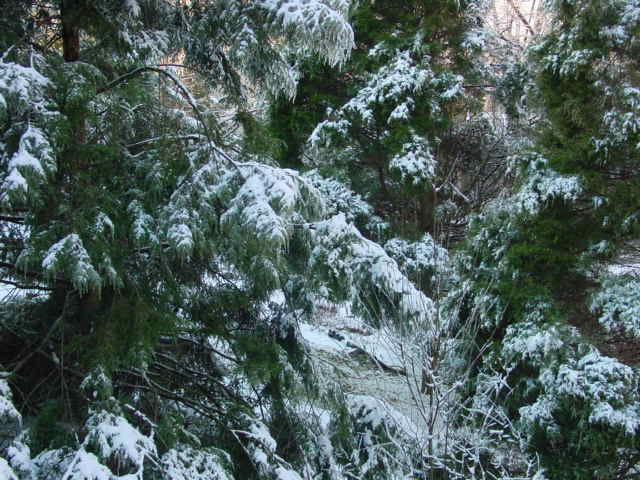
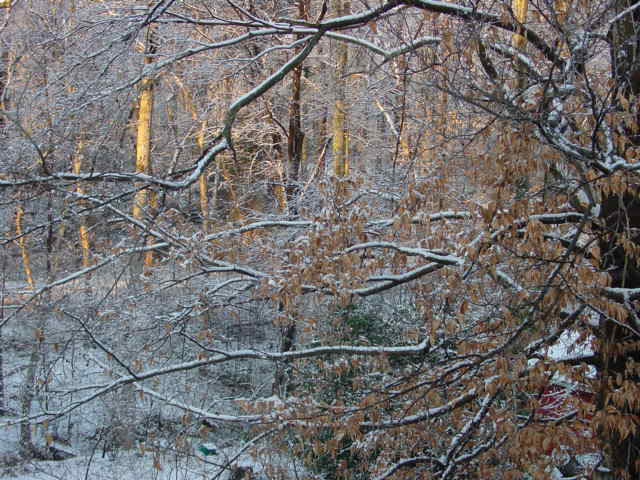
Some snap shots of a view from our house.

It snowed today on top of a nice coating of ice pellets from Saturday evening. That made for some nice scenes as the snow just laid on the branches. These pics were taken from our car port. One is of the neighbor’s (to the west) pines nicely covered with snow the other is a view of the trees in our yard and onto the school’s property to the north.

Maybe it ain’t art, but it’s home.

Compare your height for fun

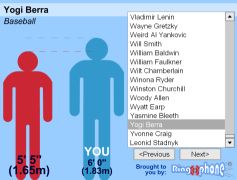
TallorNot is a fun application available at Ringphone.com. You enter your height and then select names of (other) famous people from a list. A graphic showing comparing your height to theirs is displayed. This is the place to go if you’d like an idea of what it would look like to have you standing next to Abraham Lincoln, Julia Roberts, or Yogi Berra.

Tagged

Phishing getting more sophisticated and dangerous

The article CNN.com – Experts: ‘Phishing’ more sophisticated – Jan 20, 2005 at CNN mentions some new ways that thieves are using techniques related to phishing. The quote “If you think of phishers initially as petty thieves, now they’re more like an organized crime unit,” said Paris Trudeau also ties in with an online interview with Bruce Schneier produced by the New York Times. Schneier also mentions that the situation has moved from misguided hackers getting kicks to organized crime. The CNN article also mentions that attackers have taken to modifying an individual’s host file – the file that can be used to locally translate domain names to IP addresses, and there have been attempts to compromise domain name servers — computers that serve as the authority for IP addresses.

Here’s the lead from the article “Scam artists posed as banks and other legitimate businesses in thousands of phishing attacks last year, sending out millions of “spam” e-mails with subject lines like “account update needed” that pointed to fraudulent Web sites.”

Tagged ,

The Future of the Internet

Predictions Database is the database supporting the Pew report “The Future of the Internet“.

Interesting reading. Here is a summary of the findings:

“Summary of Findings at a Glance

A broad-ranging survey of technology leaders, scholars, industry officials, and interested members of the public finds that most experts expect attacks on the network infrastructure in the coming decade. Some argue that serious assaults on the internet infrastructure will become a regular part of life.

The internet will be more deeply integrated in our physical environments and high-speed connections will proliferate – with mixed results.

In the emerging era of the blog, experts believe the internet will bring yet more dramatic change to the news and publishing worlds. They predict the least amount of change to religion.

Experts are both in awe and in frustration about the state of the internet. They celebrate search technology, peer-to-peer networks, and blogs; they bemoan institutions that have been slow to change.

These survey results and written commentary from experts add to a growing database of predictions and analysis from trendsetters about the impact of the internet.

Source: Fox, Susannah, Janna Quitney Anderson, and Lee Rainie. The Future of the Internet. Washington, DC: Pew Internet & American Life Project, January 9, 2005.”The Future of the Internet”

Congratulations to Elon University and the Pew Internet and American Life Project for putting this together.

The Elon site also contains a searchable database of predictions made in the early 1990s For example:

” From now on, the struggle will not be over mechanical control of the means of information, but over spin-control of the zeitgeist. – Bruce Sterling, 1994″. and ” Our challenge is to find ways of using the Internet and World Wide Web as a mechanism for learning for understanding, and as a mechanism for “seeing things,” not just as a highway system for haphazard. – Kimberly Rose, 1995″

Comment on wikipedia and research

apophenia: Academia and Wikipedia states an opinion about using articles in Wikipedia as citations in research papers. The author makes a good point: an entry form Wikipedia is often only form one source, and has not been vetted. There fore, it’s not appropriate as a citation. He appears to be in favor of the project (Wikipedia), but cautions on its use “I don’t believe that the goal should be ‘acceptance’ so much as recognition of what Wikipedia is and what it is not. It will *never* be an encyclopedia, but it will contain extensive knowledge that is quite valuable for different purposes. If the fuss dies down, i’d be exceptionally worried because it would mean that we’ve lost the ability to discuss the quality of information.” The entry also includes several useful comments.