Skip to content

What Wal-Mart costs us

The New York Review of Books: Inside the Leviathan – a good article detailing many of the costs we all incur through the existence of Wal-Mart and their practices.

Here are two quotes:
“One of the most telling of all the criticisms of Wal-Mart is to be found in a February 2004 report by the Democratic Staff of the House Education and Workforce Committee. In analyzing Wal-Mart’s success in holding employee compensation at low levels, the report assesses the costs to US taxpayers of employees who are so badly paid that they qualify for government assistance even under the less than generous rules of the federal welfare system. For a two-hundred-employee Wal-Mart store, the government is spending $108,000 a year for children’s health care; $125,000 a year in tax credits and deductions for low-income families; and $42,000 a year in housing assistance. The report estimates that a two-hundred-employee Wal-Mart store costs federal taxpayers $420,000 a year, or about $2,103 per Wal-Mart employee. That translates into a total annual welfare bill of $2.5 billion for Wal-Mart’s 1.2 million US employees”

“The exploitation of the working poor is now central to the business strategy favored by America’s most powerful and, by some criteria, most successful corporation. With the re-election of a president as enamored of corporate power as George W. Bush, there is every prospect that this strategy and its harsh practices will continue to spread throughout the economy.”

Another reminder that we shouldn’t shop at Wal-mart (I did once about 2 years ago, but haven’t since) and why we should discourage our friends from shopping at Wal-Mart.

A Restaurant to Remember in Zurich

Having some days off of work can be beneficial. Cleaning out a draw I came across some receipts from our trip to Switzerland this past summer, and found a receipt from a restaurant that we ate at our last night in Zurich. The restaurant was in a garden, behind a hotel. It seemed that many of the locals knew about it. We just followed some people down a path and came across the restaurant. It was really great. The name is “ZunftHaus Am Neumarkt,” with address Neumarkt 5, 8001 Zurich. You can view its location by clicking on the hyperlink under its name on this Web page.

Dr. Bruce’s Awesome Grilled Salmon

Dr. Bruce’s Awesome Grilled Salmon

Here is the salmon recipe in case you want it.
Dr. Bruce’s Awesome Grilled Salmon from “Feeding the Whole Family” by Cynthia Lair, ISBN 9780931055973.
That is out of print, but a newer version, ISBN 0966034619, is available at Amazon.

2-3 pounds Salmon Fillet. We use king salmon, wild caught in Alaska. Using a tweezer, remove pin bones from salmon.

Marinade:
2/3 cup tamari or shoyu
1/2 cup extra-virgin olive oil
2 teaspoons toasted sesame oil
2 Tablespoons grated ginger root
Juice of 1 large lime
4 cloves of garlic, minced
4 scallions, finely chopped (we sometimes leave this out)

To marinate:
Whisk all the liquids and ginger, garlic, and scallions together. Place fish in a shallow pan and pour marinade over the top. Allow to marinate 1 hour in the refrigerator. This can also be marinated out of the refrigerator, and its best to do that if the fish has been defrosted so it gets to an even temperature throughout.

To grill:
Get the grill ready – be sure the coals are white if you’re using charcoal, or heat the grill if you’re using propane. You can also do this indoors using your stove’s broiler. Put the fish skin side down on the grill. Brush or spoon marinade form dish over the salmon. There is always too much marinade to do this with all of it at once. I put marinade over the fish several times as it’s cooking. Grill about 5 minutes (the author says a rule of thumb is to cook the salmon 10 minutes for each inch of thickness, and that matches my experience.) Turn the fish over and remove the skin. it should come off very easily. Put more marinade on the fish and grill for another five minutes. You’ll have to decide after that whether it is done. Pry open a piece to see how it looks. Be sure not to overcook.
We’ve been making this recipe for years, and it is one of our favorites. The salmon always gets raves from family and friends.

about the impact of RSS, Blogs

A few links with some thoughtful remarks about the impact of RSS and Blogs.

These were gathered (mostly) from The Shifted Librarian

Tagged ,

create first, make profit later

“We’ll figure out how to monetize it later.” a quote by Lars Perkins, general manager for Picasa, in the article “Google units include social networking, photos, maps“, by Jefferson Graham, in USA Today, December 21, 2004, demonstrates what I really like about the Internet. First some things are created because they can be done, and then a plan for paying for it is developed later – for the services that survive. I mentioned that attitude in previous entry about “single-serving. com

Tagged ,

Chance of a White Christmas

Check out Weather Underground: Fredericksburg, Virginia Forecast: white christmas? to read the chances of a white Christmas in Washington DC or Baltimore. The folks at Weather Underground have done a good job analyzing the statistics of past weather conditions. It seems the chances of snow on Christmas are pretty slim, but there’s always hope. Weather Underground also has a Trip Planner that you can use to see the average temperature, wind conditions, and precipitation for a city or airport on a range of dates. We used it this past summer when we were planning our trip to Switzerland this past summer to help us decide what to pack. I really like Weather Underground and have been using their services since the early 1990s when it was only accessible via telnet. You can take advantage of their services without advertisements for a fee of only $5.00 per year. (Yeah, that’s pennies a day.)

A very nice “Single-serving”

single-serving.com phrase, trail, and travel guides

What a nice site! it contains links to printable booklets of language basics for tourists in French, German, Italian, Hungarian (that’s ho I came across this site, but that’s another story), Russian, Albanian, Czech, Polish, Swedish, Spanish, Croatian, Slovene, Danish, Afrikaans, Dutch, Portuguese, and Romanian, and partial booklets for several other languages. Radovan Anzulovic, the site’s author, also includes audio files to help with pronunciation.

A very useful and helpful site. This is yet another example of an individual using the Internet to be helpful, without starting the project as an overt commercial venture. Here is his statement of purpose taken from the section About: “My goal is to create the best phrase guides and language aides on the web. My purpose is not as clear. I am obviously putting a lot of personal time and money into it. My purpose is really to be satisfied that I have a fantastic product. Of course I dream of being able to someday live from something that I’m doing on the web. I could then live anywhere, or travel anywhere, and still be at work. (But how realistic is that?)” My comment: Be careful what you wish for. Too many of us are working wherever we are by taking along the connecting technology.

This is a first-class, easy-to-use, and helpful site. Congratulations.

Tagged ,

The Botany of Desire

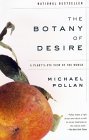
botany of desire I just finished reading “The Botany of Desire: A Plant’s-Eye View of the World” by Michael Pollan. What an enjoyable book! Pollan’s writing is intelligent, witty, and just a pleasure to read.

We correctly have the notion that we effect the plants in our environment. Not doubting that or diminishing our role in our environment, Pollan writes about the effect that plants have humans. The ways they have changed us, just as we have been changing them through selective breeding and most recently through genetic engineering. Reading this book reinforces the notion that humans and plants are connected, not separate from each other in the world. He does this by taking an in-depth view of the interplay between humans and four representative plants: apples, tulips, marijuana, and potatoes. All the while I reading it I felt I was with a kind, smart friend. The book is wonderful and I’m looking forward to reading some of his other work.

Here’s a favorite quote from the book: ” There is another word for this extremist noticing –this sense of first sight unencumbered by knowingness, by the already-been-theres and seen-thats of the adult mind–and that word, of course, is wonder. Memory is the enemy of wonder, which abides nowhere else but in the present. This is why, unless you are a child, wonder depends on forgetting–on a process,that is, of subtraction.”

hyperlink tips

We had a brief discussion about using “click here” as a hyperlink in my Internet course yesterday. The following annotated list provides guidance in creating hyperlinks:

Hyperlink Issues and Design. A brief guide to creating effective hyperlinks.

Writing Links That Your Readers Will Click On, Web Writing: Good Links are Crucial to Have Clear Powerful Web Prose. Part of the work by Jennifer Kyrin dealing with writing for the Web at about.com. Includes links to other pages about creating hyperlinks.

What is good hypertext writing?. Jutta Degener’s comments on writing for the Web. “There is more to writing than putting words next to each other, and there is more to writing hypertext than throwing together a bunch of links. ”

Don’t say “click here”; not everyone will be clicking – Quality Web Tips. Tips and links to more tips, Quality Assurance Activity at the World Wide Web Consortium.

Tagged ,

Notes from a test

Grading the take-home test from CPSC 104, The Internet: Technology, Issues & Information makes me want to write down a few things to help myself for the next time I teach the course.

Emphasize the different types of writing that will have to be done. On the test students were asked to write a research piece, an opinion piece that was supported by other sources, a site review, and step-by-step instructions. These are typical types of webwriting and the course should include at least one assignment for each type of writing.

Stress the differences between the notions of accuracy and objectivity. Use a site that contains accurate info, but with a slant.

Stress research about an author, even if there is no information at a site that carries the author’s work. Find out who the author is, what other works she has produced, etc.

Check resources for actual date of authorship, not only using the date on a Web page.